Welcome to the UArizona HPC Documentation Site

Introduction
The University of Arizona offers High Performance Computing (HPC) resources in the Research Data Center (RDC), a state-of-the-art facility that hosts our large computer clusters. HPC services are available at no cost to researchers. Each faculty member is eligible for a free standard allocation of CPU time and storage space.
This documentation site provides technical details relevant to using our HPC system. Whether you are just starting your journey into computational sciences or are a seasoned programmer, we hope you will find something useful in these pages. This site is managed by the HPC Consult team. Please contact us if you have questions or comments about the content of this site.
Fall 2026 HPC Workshops Available
See our Events Calendar for more!
Featured Links
-
If you are an active UArizona affiliate (e.g. student, post-doc, faculty), you can register an account. If you are not affiliated with UArizona but are working with collaborators here, you can register as a Designated Campus Colleague (DCC).
-
If you are new to the UArizona HPC, or to HPC in general, our self-guided quick start tutorial will provide a solid foundation for using our system.
-
Find out how to contact the HPC Consult team, or view our FAQs, glossary, cheat sheets, and more!
-
Events Calendar | Workshop Materials
Every semester we host training sessions on topics including intro to HPC, machine learning, parallel computing, and beyond. Click the link above to see our workshop schedule, our old training materials, and find more workshops from around campus.
-
User Publications | Research Stories
Our users do some really cool stuff! Want to see what they've been up to? Check out a list of publications that were made possible by our computing infrastructure and some in-depth stories behind those publications in our research showcase.
System Highlights FY 2026
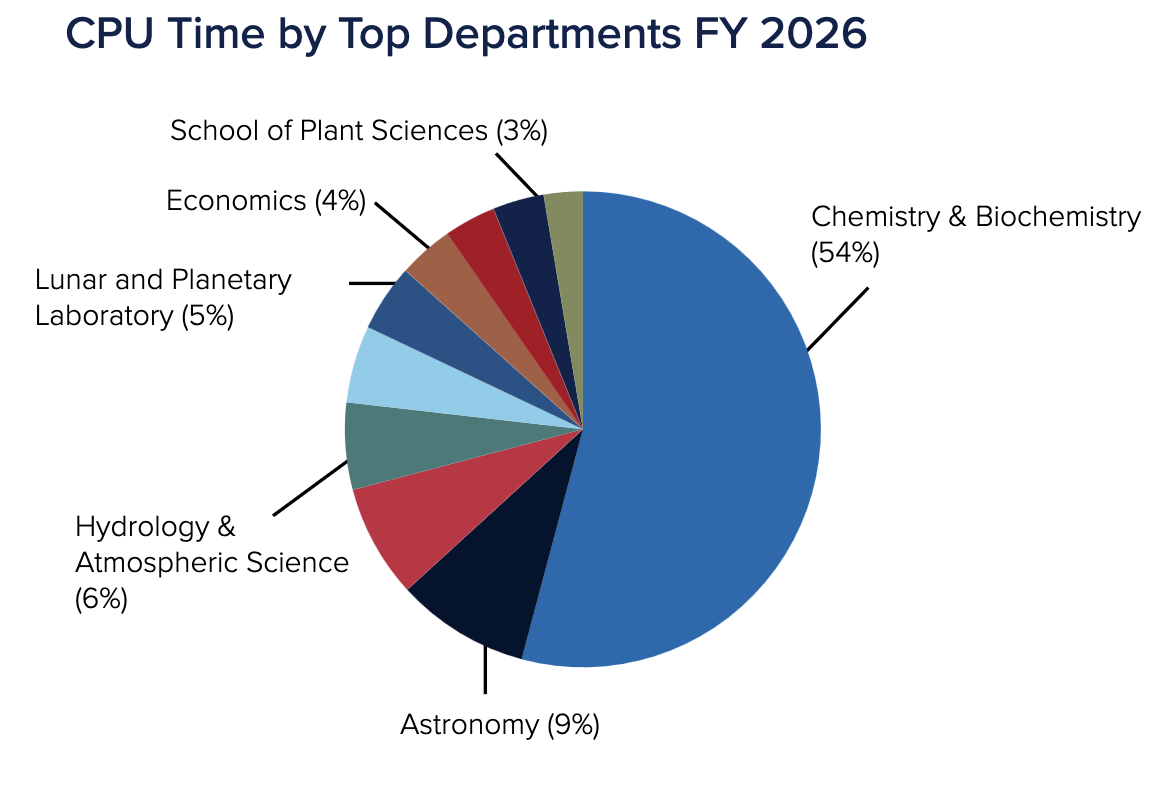
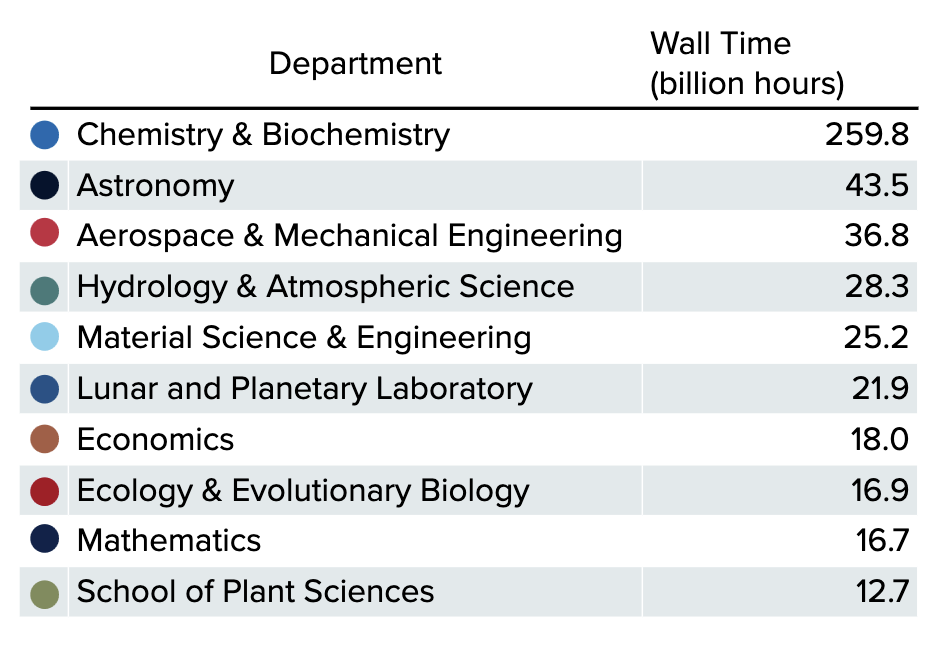
Over the past four years, Puma has been a vital resource for researchers at the University of Arizona. In fiscal year 2025, our systems supported over 300 million compute hours enabling diverse research spanning climate modeling, genomics, neuroimaging, and more. With more than 80 active departments, 500 principal investigators, and 1,500 users, Puma continues to advance discovery and innovation.
Researchers rely on our HPC resources not only for computational power, but also for expert support. This past year, we assisted users with nearly 2000 support requests. Explore highlights from this year, including testimonials from researchers and key statistics by downloading the full annual report.
Highlighted Research

To help unlock the mysteries of how our brains age, the Precision Aging Network (PAN) is examining MRIs of more than 1,000 diverse participants across four American cities. The nationwide study, led by Dr. Carol Barnes, is looking at how factors like heart health, blood sugar, inflammation, and even genetics influence cognitive decline as we age.
Each participant undergoes a series of detailed brain scans—anatomical, functional, diffusion, and perfusion MRI, which provide a rich view of brain structure and activity. Then the university’s Brain and Body Imaging Center relies on the U of A Research Data Center’s high-performance computing (HPC) systems to process and analyze the millions of 3D data points, called voxels, per scan.
Read more about HPC support of PAN
For more cool stories on what our users do, see our research showcase.
Available Resources
Our Clusters (click to expand)
 Implemented in the middle of 2020, Puma is the biggest cat yet. Similar to Ocelote, it has standard CPU nodes (with 94 cores and 512 GB of memory per node), GPU nodes (with Nvidia V100) and two high-memory nodes (3 TB). Local scratch storage increased to ~1.4 TB. Puma runs on Rocky Linux 9.
As is the case for our other supercomputers, we use the RFP process to get the best value for our financial resources, that meet our technical requirements. This time Penguin Computing one with AMD processors. This is tremendously valuable as each node comes with:
- Two AMD Zen2 48 core processors
- 512GB RAM
- 25Gb path to storage
- 25Gb path to other nodes for MPI
- 2TB internal NVME disk (largely available as /tmp)
- Qumulo all flash storage array for shared filesystems
- Two large memory nodes with 3TB memory and the same processors and memory as the other nodes
- Six nodes with four Nvidia V100S GPU's each
Compute
UArizona HPC systems are available to all university faculty, staff, undergraduate and graduate students, postdocs, and designated campus colleagues (DCCs) at no cost. Researchers have access to compute resources on our two clusters, Ocelote and Puma, located in our data center. Presently each research group is provided with a free standard monthly allocation on each: 150,000 CPU-hours on Puma and 100,000 CPU-hours on Ocelote.
Funding Sources
UArizona HPC systems are funded through the UArizona Research Office (RII) and CIO/UITS (Chief Information Officer, and University Information Technology Services). Staff is funded to administer the systems and provide consulting services (no charge) for all researchers.
Regulated Research
These resources specifically do not support Regulated Research, which might be ITAR, HIPAA or CUI (Controlled Unclassified Information). For more information on services that can support regulated research, see: HIPAA support services and CUI support services.
News
-
Clusters Decommissioning
We will be decommissioning two of our older clusters in the summer of 2026 to make space for the new cluster, Lynx. The dates for the decommissioning are as follows:
- El Gato went permanently on Wednesday, July 29th, 2026.
- Ocelote went offline permanently on Monday, August 17th, 2026.
Ocelote and El Gato users will need to migrate their workflows to Puma to continue using HPC. Information on how to do this can be found in our operating system updates documentation.
-
July 2026 Maintenance
There will be an upcoming maintenance period on July 29th, 2026. This will be a rolling maintenance period so there will be no system downtime.
During this maintenance period, our documentation will be updated to have a different look!
-
Update on Plans for a New Cat
The university’s Research Data Center (RDC) is preparing to install its next HPC cluster in fall 2026. The new system will have 40 nodes of CPU compute, two 8-GPU nodes with H200 GPUs, and one 3TB High-memory node, and will incorporate InfiniBand networking for MPI capabilities.
-
New user tools
We have two very useful command-line tools to make your workflow a little easier.
Have you tried to find what all the data is in your home directory, or why it is taking up so much space?
The command
gducan be run from a login node and will, by default, sort your directories by size, including hidden directories.What about reviewing recent jobs for some brief metrics and analyzing their efficiency? Maybe you need to assign more memory. Or less. Try
multiseff -h, also from the login nodes.
Acknowledgements
Published research that utilized UArizona HPC resources should follow our guidelines on how to acknowledge us.
If you wish for your research to be featured in our Results page, please contact HPC consult with news of the publication!
We respectfully acknowledge the University of Arizona is on the land and territories of Indigenous peoples. Today, Arizona is home to 22 federally recognized tribes, with Tucson being home to the O’odham and the Yaqui. Committed to diversity and inclusion, the University strives to build sustainable relationships with sovereign Native Nations and Indigenous communities through education offerings, partnerships, and community service.